
According to Allagash Brewing’s newsletter, beginning tomorrow in San Diego, owner/brewer Rob Tod will be on a beer odyssey of his own as he winds his way from the left coast to the right, ending up in Atlantic City, no doubt with a ring on his finger and no memory of how he got there.
Archives for January 16, 2007
Faux Canada
According to an article in today’s Montreal Gazette, Canadians are increasingly looking to buy better tasting beer. And like their American cousins, the big Canadian breweries are flooding the market with faux or stealth microbrews in order to compete with craft brewers. With these faux craft beers, they’re trying to fool customers into thinking they’re getting just want they want, a beer that’s been hand-crafted to taste great.
Labatt has a line called Alexander Keith, named for an early brewer in Nova Scotia. MolsonCoors, likewise, has Rickard’s family of brands. Both Rickard’s and Keith’s are listed on their respective company websites and acknowledged as their brands. Alexander Keith’s own website does disclose that it’s a Labatt brand, but only in the legal stuff like “terms of use.” They certainly don’t go out of their way to associate themselves with the parent company.
An interesting parallel, though the article goes on to discuss tarrifs between provinces and what their removal will mean for small players. I don.t know enough about the market to form an opinion, but it’s an interesting read.
Alexander Keith’s IPA, owned by Labatt; and Rickard’s Red, owned by MolsonCoors.
The Duchesse

Jon Bonné, the new big cheese at the San Francisco Chronicle’s wine section, had a little blurb in the Sipping News about a wonderful beer, the Duchesse de Bourgogne, imported by D&V International.
Bonné claims it’s a beer for wine lovers, though I assume he means others might enjoy it, too. His pairing suggestions are intriguing, matching it with “rich cream dishes (with mussels, for instance) or a firm, bold-flavored cheese like an aged Gouda.” He also mentions the City Beer store — 1168 Folsom (at 7th), 415.503.1033 — as a place to buy it, and it’s good to see them get some love. I could make a big deal out of Bonné’s selling as a beer for cork dorks, but I’m hoping what he’s trying to do is get people who might not otherwise try a sophisticated beer to try one, and because I’m trying to give him the benefit of the doubt after his gracious response to my earlier criticism about one of the first beer pieces he green-lighted after coming to the Chronicle.
Duchesse de Bourgogne is a favorite of mine, as I love the style — Flanders Red Ale — and I usually order one if I find it on a beer list. I was thrilled to see it in California beginning last year. It’s brewed at the Brouwerij Verhaeghe, located in Vichte, which is a ancient castle and farm in West Flanders, Belgium. By the way, it’s pronounced “Doo-shay.”
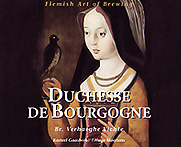
Beer aside, the history of the Duchesse is fascinating. Her anglicized name was Mary of Burgundy, though she was born in Brussels on February 13, 1457, the only child of Charles the Bold, Duke of Burgundy, and his wife Isabella of Bourbon. Needless to say she was quite a catch, especially after her father died in battle (at the siege of Nancy, not a particularly awful sounding name) in 1477, when she was nineteen. Louis XI of France tried to take Burgundy and the Low Countries for himself but was frustrated when Mary signed the “Great Privilege,” by which she gave Flanders, Brabant, Hainaut, and all of Holland autonomous rule (leaving for herself the remainder of the Low Countries, Artois, Luxembourg, and Franche-Comté). She then married Archduke Maximilian of Austria, who was later the Holy Roman Emperor Maximilian I, and part of the Hapsburg Austrian dynasty. This sparked a long-standing dispute over the Low Countries between France and the Hapsburg family.
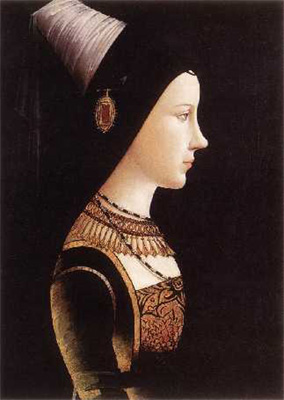
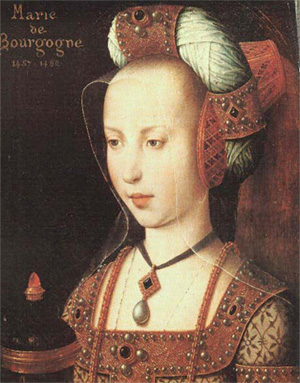
Two portraits of Mary of Burgundy, the Duchesse de Bourgogne.
One of Mary’s favorite hobbies was falconing, which was popular among royals in the day. Falconry is basically training and hunting using a falcon. While engaged in this pursuit, in 1482, Mary’s horse tripped, tossing her onto the ground where the horse then landed on top of her, breaking her back. A few days later she died. Mary was only 25. The beer label’s portrait pays homage to her love of falconry and her ultimate death because of it.
Her young son Philip became heir after her death, though Maximilian was in charge until he reached adulthood. King Louis forced Maximilian to sign the Treaty of Arras the same year, and it gave Franche Comté and Artois to France. But Philip was a virtual prisoner until 1485, and then it took Max another eight years to take back control of their lands in the Low Countries. The Treaty of Senlis, in 1493, finally established peace in the area, but Burgundy and Picardy remained French.
So during her short life, Mary had such great impact on European politics that they can be felt even now in the present. So it’s quite appropriate that she have so wonderful a beer that bears her name and her portrait. It’s a fitting legacy.
The description of the beer from the importer:
The Duchesse de Bourgogne from Brouwerij Verhaeghe is the traditional Flemish red ale. This refreshing ale is matured in oak casks; smooth with a rich texture and interplay of passion fruit, and chocolate, and a long, dry and acidic finish. After the first and secondary fermentation, the beer goes for maturation into the oak barrels for 18 months. The final product is a blend of younger 8 months old beer with 18 months old beer. The average age of the Duchesse de Bourgogne before being bottled is 12 months.