Today is the feast day of St. Veronus. He is the patron saint of Lambeek & Belgian brewers. He was also known as Veronus van Lembeek, and he was a professor or a farmhand (accounts differ) who lived in Belgium in the 9th century.
This short account of his life is from his Dutch Wikipedia page, translated by Google:
The life of Veronus is known from a hagiography written by Olbert van Gembloers around 1015-1020.
According to legend, Veronus was a great-grandson of Charlemagne. He left the parental home at the age of 15, because he did not want to get married, and ended up in Lembeek. Here he settled and served as a servant on a farmyard.
Once when he hammered a stick into the ground, water immediately bubbled from the ground. He told his twin sister, Saint Verona, where he would be buried after his death. A fallen tree would show her the way. After his death it happened as he had foreseen.
Woodcut of Veronus dressed as a pilgrim and holding a staff standing outside a farmhouse, where a woman is pouring liquid from a churn, from c.1516-8.
And this account is from Heiligen, a German website devoted to saints, also translated by Google.
Veronus was of fairly high descent. He is said to have been a cousin of Charles the Bald († 877). He left his parental home because he did not agree with the plans of his parents who liked to see him married and with an appropriate party. He himself walked around desiring to devote himself entirely to the service of God, and thus not to marry. On his departure, he informed his sister Verona (9th century; feast day, August 29) that in due time a sign would indicate the time and place of his death: a storm would arise and the trees would blow over and fall in towards the place where he is said to have died. After some wanderings, he ended up on a court farm in Lembeek. There he hired himself out as a farmhand. He lived a life of simplicity and service.
Legend tells how he drilled a well when he once planted his stick in the ground near the church. After all, according to the chronicles, he died “loved by God and by men.”
Indeed, his death was accompanied by the signs he had announced to his sister at the time. So she left in the indicated direction and ended up in Brabant. The horses stopped in Berchem. There she was told that she had to continue to Lembeek. She found her brother’s grave in the local church. The moment she entered the body emitted a wonderful scent. The tomb was opened and the dead was found completely intact. Over the centuries, the memory of Veronus faded. He is said to have appeared to a priest on the spot to remind him of his memory. The priest began to work for the restoration of the worship of Veronus, and the latter expressed his agreement by delighting many pilgrims with answers to prayers and other miracles.
Modern Usages
There’s a St. Veronus Cafe and Tap Room located in Peterborough, Ontario, Canada. They bill themselves as a Belgian restaurant and beer bar.
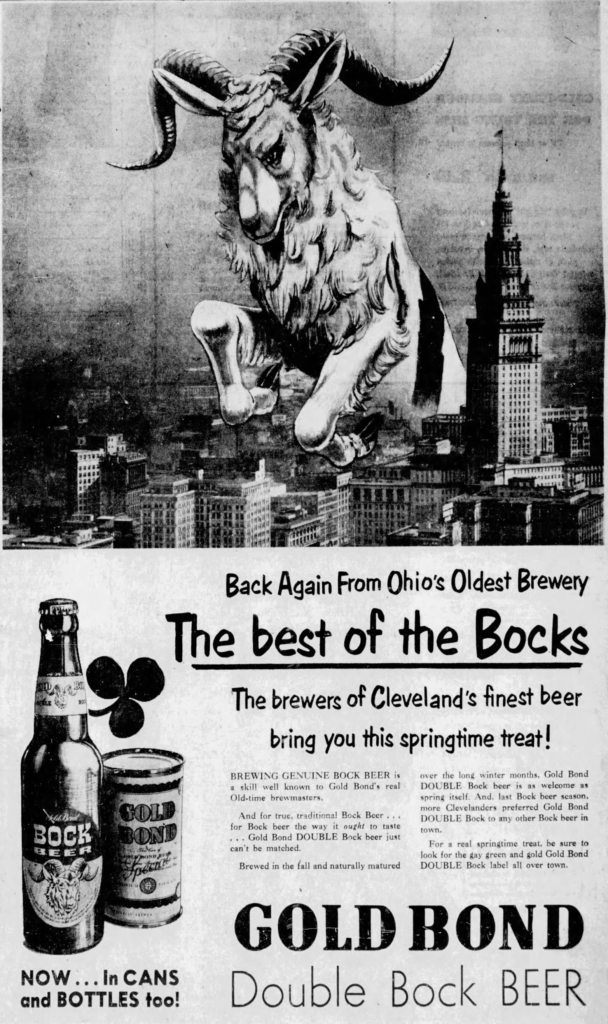
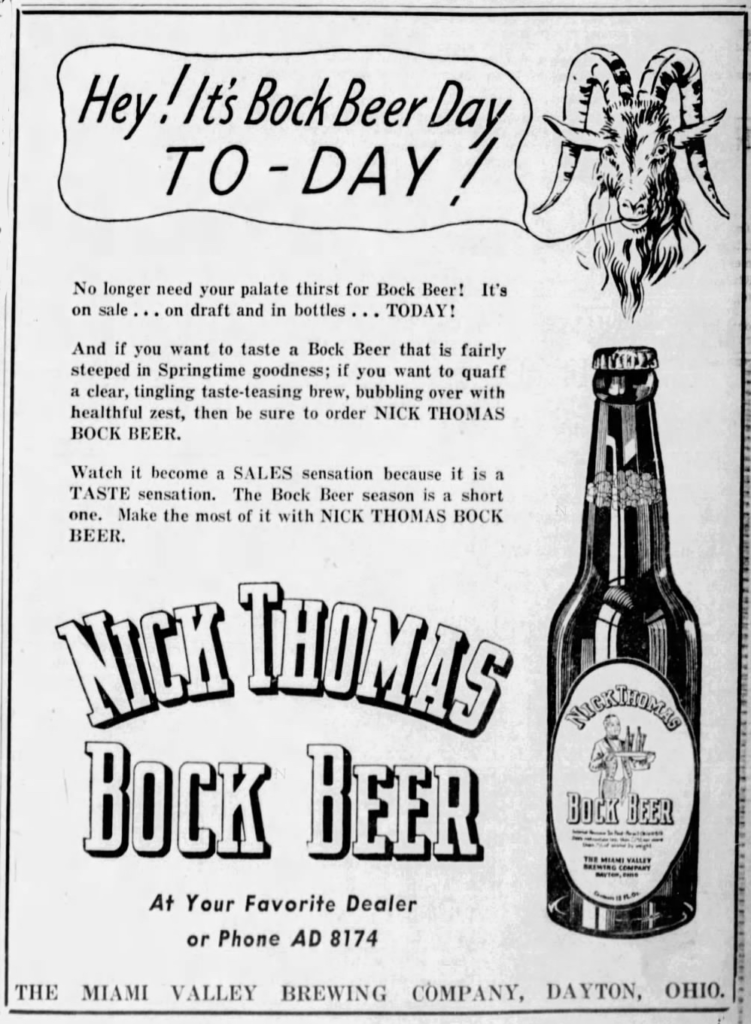
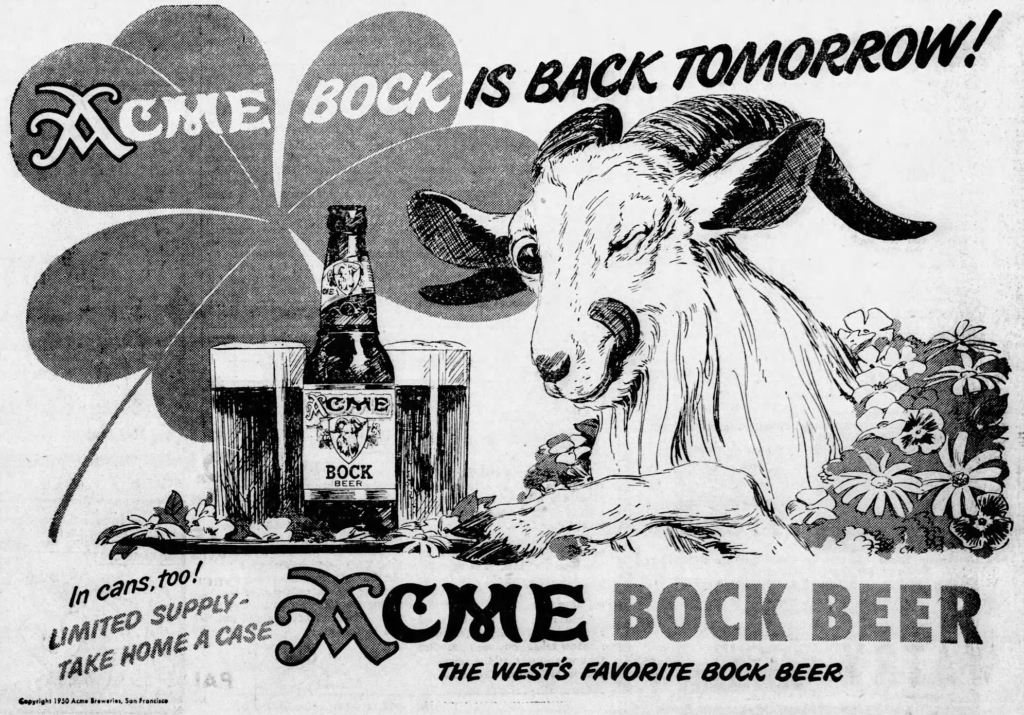
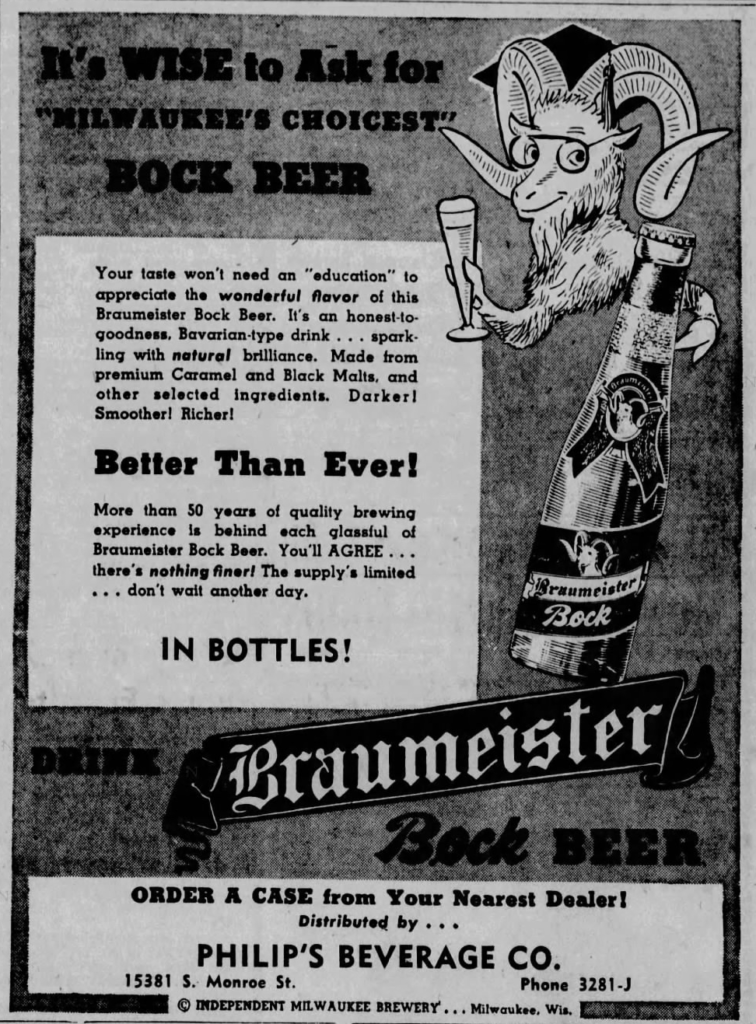
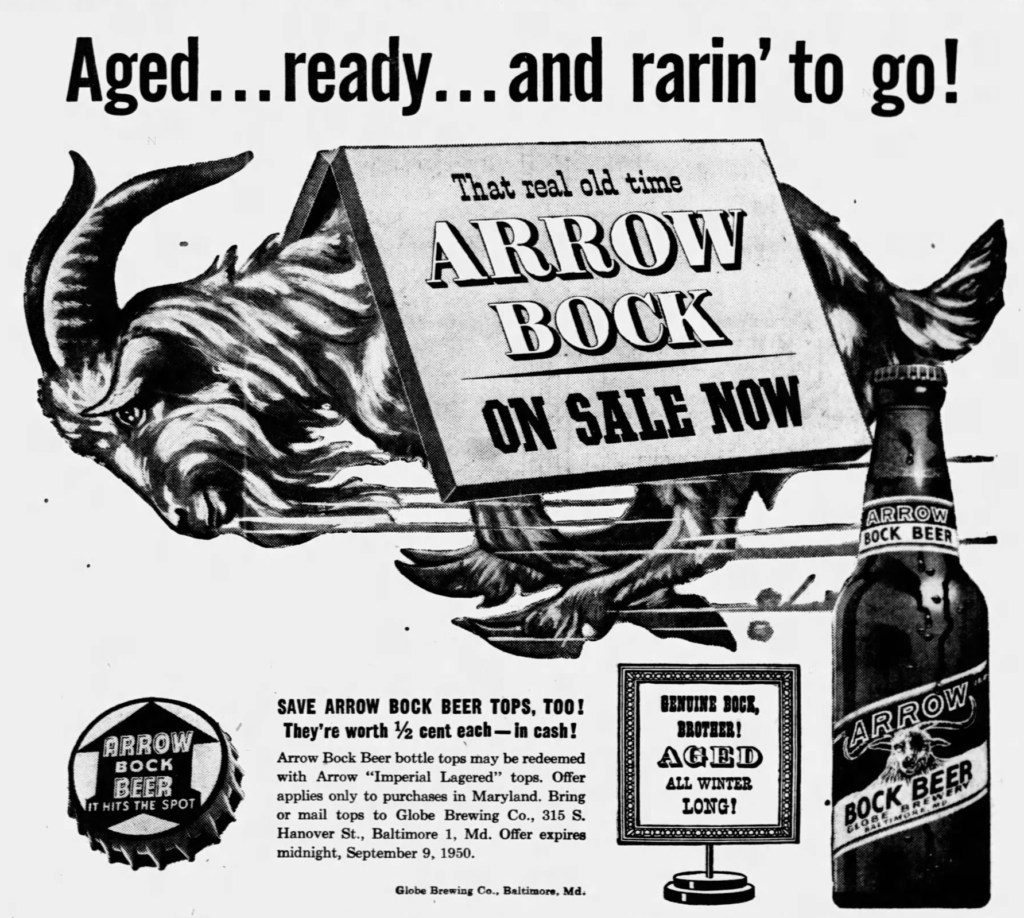
Two years ago I decided to concentrate on Bock ads for awhile. Bock, of course, may have originated in Germany, in the town of Einbeck. Because many 19th century American breweries were founded by German immigrants, they offered a bock at certain times of the year, be it Spring, Easter, Lent, Christmas, or what have you. In a sense they were some of the first seasonal beers. “The style was later adopted in Bavaria by Munich brewers in the 17th century. Due to their Bavarian accent, citizens of Munich pronounced ‘Einbeck’ as ‘ein Bock’ (a billy goat), and thus the beer became known as ‘Bock.’ A goat often appears on bottle labels.” And presumably because they were special releases, many breweries went all out promoting them with beautiful artwork on posters and other advertising.
Friday’s ad is for Hampden Bock Beer, which was published on January 30, 1935. This ad was for the Hampden Brewing Co., of Willmansett, Massachusetts, which was originally founded in 1878 by William Brierly, although he only owned it for one year. It then a few new owners, and different names, before being known as Hampden in 1890, which remained in the name until 1962, but after that had another series of owners before closing in 1974. This ad ran in The Morning Union, also of Springfield, Massachusetts.
Two years ago I decided to concentrate on Bock ads for awhile. Bock, of course, may have originated in Germany, in the town of Einbeck. Because many 19th century American breweries were founded by German immigrants, they offered a bock at certain times of the year, be it Spring, Easter, Lent, Christmas, or what have you. In a sense they were some of the first seasonal beers. “The style was later adopted in Bavaria by Munich brewers in the 17th century. Due to their Bavarian accent, citizens of Munich pronounced ‘Einbeck’ as ‘ein Bock’ (a billy goat), and thus the beer became known as ‘Bock.’ A goat often appears on bottle labels.” And presumably because they were special releases, many breweries went all out promoting them with beautiful artwork on posters and other advertising.
Thursday’s ad is for Graupner’s Bock Beer, which was published on January 29, 1948. This ad was for the Graupners of Harrisburg, Pennsylvania, which was originally founded in 1875 by Edward and John Koenig, by Robert H. Graupner bought the brewery in 1893 and he, and then his family, ran it until 1951. This ad ran in The Harrisburg Telegraph, also of Harrisburg, Pennsylvania.
Two years ago I decided to concentrate on Bock ads for awhile. Bock, of course, may have originated in Germany, in the town of Einbeck. Because many 19th century American breweries were founded by German immigrants, they offered a bock at certain times of the year, be it Spring, Easter, Lent, Christmas, or what have you. In a sense they were some of the first seasonal beers. “The style was later adopted in Bavaria by Munich brewers in the 17th century. Due to their Bavarian accent, citizens of Munich pronounced ‘Einbeck’ as ‘ein Bock’ (a billy goat), and thus the beer became known as ‘Bock.’ A goat often appears on bottle labels.” And presumably because they were special releases, many breweries went all out promoting them with beautiful artwork on posters and other advertising.
Wednesday’s ad is for Walter’s Bock Beer, which was published on January 28, 1966. This ad was for the Walter Brewing Co. of Pueblo, Colorado, which was originally founded in 1889 in Eau Claire, Wisconsin by Johannes Walter, while his brother Martin Walter opened a location in Colorado in 1898. This ad ran in The Daily Sentinel, of Grand Junction, Colorado.
Two years ago I decided to concentrate on Bock ads for awhile. Bock, of course, may have originated in Germany, in the town of Einbeck. Because many 19th century American breweries were founded by German immigrants, they offered a bock at certain times of the year, be it Spring, Easter, Lent, Christmas, or what have you. In a sense they were some of the first seasonal beers. “The style was later adopted in Bavaria by Munich brewers in the 17th century. Due to their Bavarian accent, citizens of Munich pronounced ‘Einbeck’ as ‘ein Bock’ (a billy goat), and thus the beer became known as ‘Bock.’ A goat often appears on bottle labels.” And presumably because they were special releases, many breweries went all out promoting them with beautiful artwork on posters and other advertising.
Tuesday’s ad is for Bruton Bock Beer, which was published on January 27, 1939. This ad was for the Bruton Brewing Co. of Baltimore, Maryland, which was originally founded in 1855 by George Neisendorfer. Over the years it had several owners and a variety of names, and for it’s last five years in business, from 1935-1940, it was known as the Bruton Brewing Co. This ad ran in The Evening Sun, also of Baltimore, Maryland.
Two years ago I decided to concentrate on Bock ads for awhile. Bock, of course, may have originated in Germany, in the town of Einbeck. Because many 19th century American breweries were founded by German immigrants, they offered a bock at certain times of the year, be it Spring, Easter, Lent, Christmas, or what have you. In a sense they were some of the first seasonal beers. “The style was later adopted in Bavaria by Munich brewers in the 17th century. Due to their Bavarian accent, citizens of Munich pronounced ‘Einbeck’ as ‘ein Bock’ (a billy goat), and thus the beer became known as ‘Bock.’ A goat often appears on bottle labels.” And presumably because they were special releases, many breweries went all out promoting them with beautiful artwork on posters and other advertising.
Monday’s ad is for Leidiger Bock Beer, which was published on January 26, 1910. This ad was for the Leidiger Brewing Co. of Merrill, Wisconsin, which was originally founded in 1884 by George Ruder, and the Leidiger family appears to have bought the brewery around 1895. This ad ran in The Merrill Star Advocate, also of Merrill, Wisconsin.
Two years ago I decided to concentrate on Bock ads for awhile. Bock, of course, may have originated in Germany, in the town of Einbeck. Because many 19th century American breweries were founded by German immigrants, they offered a bock at certain times of the year, be it Spring, Easter, Lent, Christmas, or what have you. In a sense they were some of the first seasonal beers. “The style was later adopted in Bavaria by Munich brewers in the 17th century. Due to their Bavarian accent, citizens of Munich pronounced ‘Einbeck’ as ‘ein Bock’ (a billy goat), and thus the beer became known as ‘Bock.’ A goat often appears on bottle labels.” And presumably because they were special releases, many breweries went all out promoting them with beautiful artwork on posters and other advertising.
Sunday’s ad is for Delmarva Bock Beer, which was published on January 25, 1943. This ad was for the Delmarva Brewing Co. of Wilmington, Delaware, which was originally founded in 1878 by Carl Specht. Over the years it had a variety of owners and names, and was known as Delmarva (Delaware-Maryland-Virginia) only from 1938 to 1944. This ad ran in The News Journal, also of Wilmington, Delaware.
Two years ago I decided to concentrate on Bock ads for awhile. Bock, of course, may have originated in Germany, in the town of Einbeck. Because many 19th century American breweries were founded by German immigrants, they offered a bock at certain times of the year, be it Spring, Easter, Lent, Christmas, or what have you. In a sense they were some of the first seasonal beers. “The style was later adopted in Bavaria by Munich brewers in the 17th century. Due to their Bavarian accent, citizens of Munich pronounced ‘Einbeck’ as ‘ein Bock’ (a billy goat), and thus the beer became known as ‘Bock.’ A goat often appears on bottle labels.” And presumably because they were special releases, many breweries went all out promoting them with beautiful artwork on posters and other advertising.
Saturday’s ad is for Labatt’s Bock Beer, which was published on January 24, 1966. This ad was for the Labatt Brewing Co. of Toronto, Ontario in Canada, which was originally founded in 1847. This ad ran in The North Bay Nugget, also of North Bay, Ontario in Canada.
Two years ago I decided to concentrate on Bock ads for awhile. Bock, of course, may have originated in Germany, in the town of Einbeck. Because many 19th century American breweries were founded by German immigrants, they offered a bock at certain times of the year, be it Spring, Easter, Lent, Christmas, or what have you. In a sense they were some of the first seasonal beers. “The style was later adopted in Bavaria by Munich brewers in the 17th century. Due to their Bavarian accent, citizens of Munich pronounced ‘Einbeck’ as ‘ein Bock’ (a billy goat), and thus the beer became known as ‘Bock.’ A goat often appears on bottle labels.” And presumably because they were special releases, many breweries went all out promoting them with beautiful artwork on posters and other advertising.
Friday’s ad is for Stegmaier Bock Beer, which was published on January 23, 1959. This ad was for the Stegmaier Brewing Co. of Wilkes-Barre, Pennsylvania, which was originally founded in 1857. This ad ran in The Times Leader, also of Wilkes-Barre, Pennsylvania.
Two years ago I decided to concentrate on Bock ads for awhile. Bock, of course, may have originated in Germany, in the town of Einbeck. Because many 19th century American breweries were founded by German immigrants, they offered a bock at certain times of the year, be it Spring, Easter, Lent, Christmas, or what have you. In a sense they were some of the first seasonal beers. “The style was later adopted in Bavaria by Munich brewers in the 17th century. Due to their Bavarian accent, citizens of Munich pronounced ‘Einbeck’ as ‘ein Bock’ (a billy goat), and thus the beer became known as ‘Bock.’ A goat often appears on bottle labels.” And presumably because they were special releases, many breweries went all out promoting them with beautiful artwork on posters and other advertising.
Thursday’s ad is for Neuweiler Bock Beer, which was published on January 22, 1960. This ad was for the Neuweiler Brewing Co. of Allentown, Pennsylvania, which was originally founded in 1875 by Benedict Nuding. Nuding retired in 1900, and Neuweiler bought him out, but didn’t change the name until 1905. This ad ran in The Morning Call, of Allentown, Pennsylvania. In case you’re curious, “Nix Besser” is a Pennsylvania Dutch phrase I grew up with which means “none better.” It’s believed to have been derived from “nichts besser,” which means “nothing better” in German.