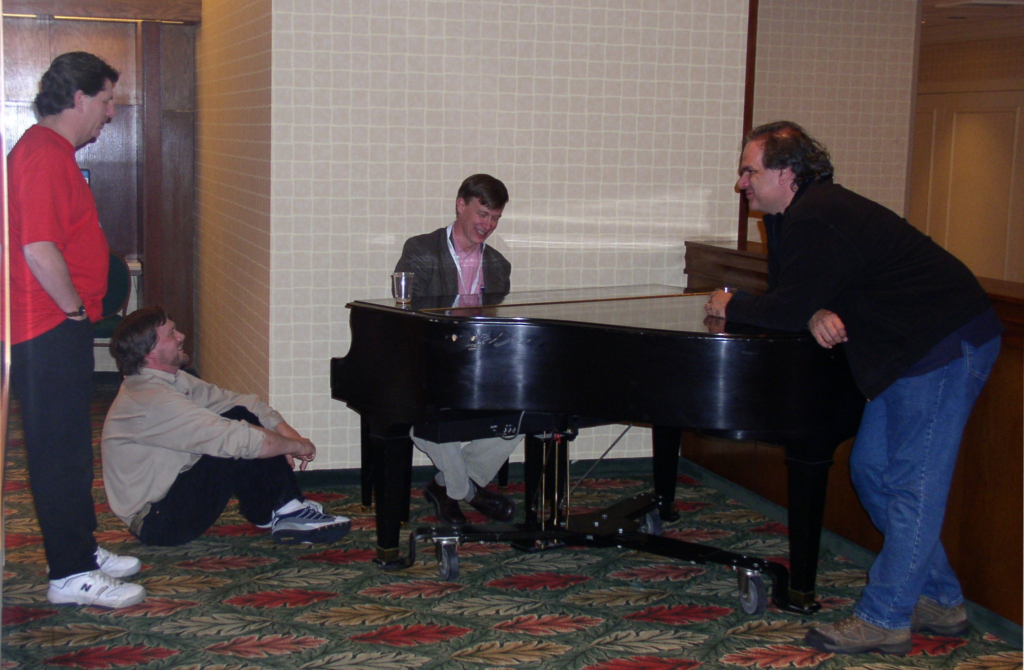
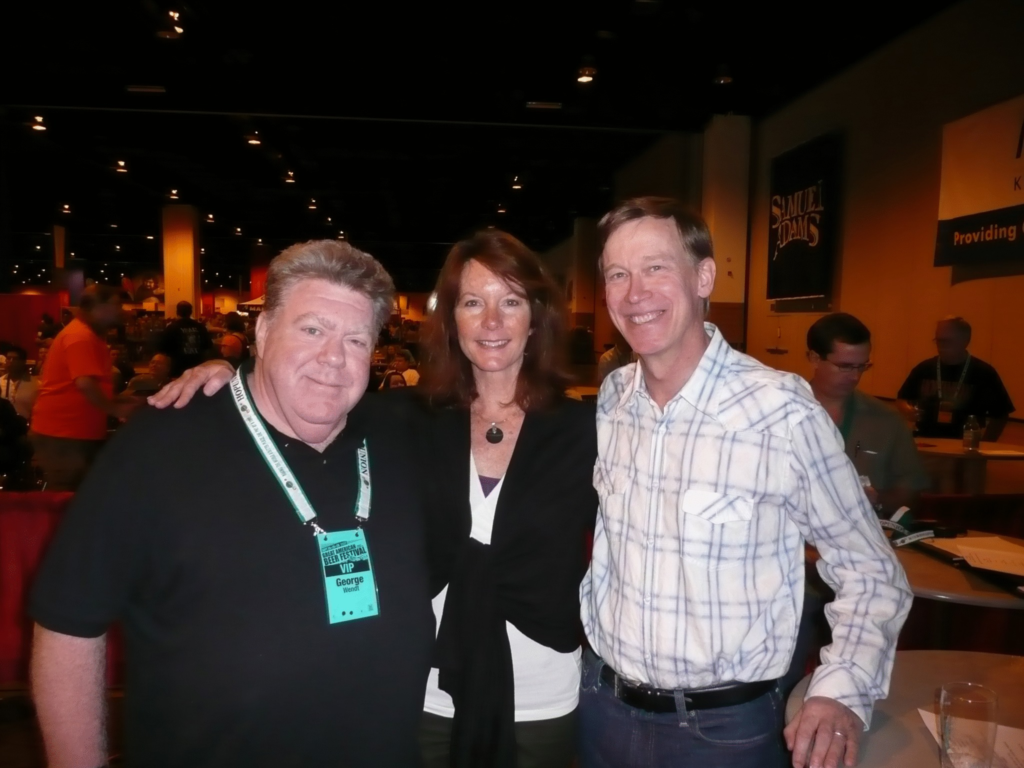
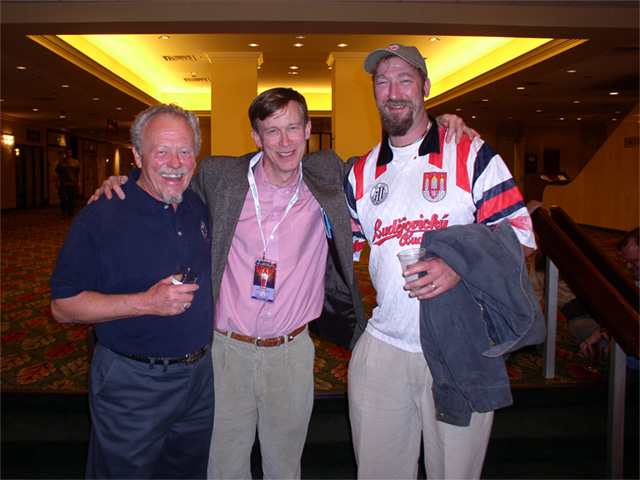
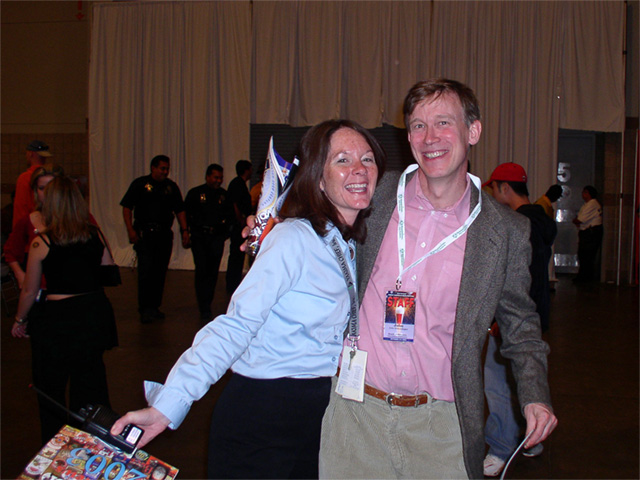
The Pink Boots Society, the organization of women in beer founded by Teri Fahrendorf, held their first meeting during the recent Craft Brewers Conference on April 19. Teri used to be in charge of brewing operations for the Steelhead chain of brewpubs, but left that job to travel around the country, a journey which she documented as the Road Brewer. Around the same time, she started the Pink Boots Society to be a group of women brewers and related beer occupations that would advocate for women in the industry.
16 women brewers & cellarwomen attended the first meeting, as listed below in no particular order.
Teri Fahrendorf (Formerly Steelhead Brewery), Laura Ulrich (Stone Brewing), Jessica Gilman (Stone Brewing), Alysha Heck (Orlando Brewing), Barbara Gerovac (Red Car Brewery), Emily Thomas (Santa Cruz Mountain Brewing), Erin Glass (Formerly New Belgium, now with the Brewers Association), Hayley Meagher (Rock Bottom - Long Beach), Maribeth Raines (Great Beer Company), Michelle Lowney (Formerly Phantom Canyon, now a Consultant in Canada), Jamie Martin (Dells Brewing), Tonya Cornett (Bend Brewing), Denise Jones (Moylan’s), Laurie Wright Matthews (Island Brewing), Carol Stoudt (Stoudt Brewing), Alyson Tomlin (R & B Brewing).
If you enjoyed this post or the Bulletin generally, please consider buying me a pint
![]()
A California state legislator, Jim Beall, Jr. of San Jose, is proposing a bill that will raise the taxes on beer a staggering $1.80 per six-pack or 30-cents a bottle, which amounts to over a 1400% increase! In addition, the tax on draft beer would be an additional $90 per keg, almost doubling their cost. Yeah, that sounds reasonable. This is his first term in the state assembly so perhaps he’s trying to make a name for himself. Any bill of this type needs a two-thirds majority to pass (doubtful at best) and then also, “because it’s a constitutional amendment, it would have to be approved by voters.” I’d be surprised to see voters agree to have the price of beer raised by that much. But even so, it’s worth looking at the propaganda behind Beall’s rationale, as it seems to come directly from the neo-prohibtionist playbook.
Mike Fox Sr., from the San Jose beer distributor M.E. Fox, said “Beall’s heart is in the right place” because he’s “dedicated in areas of health.” That’s far more credit than I’m willing to give him. As Dan Gordon puts it, far more realistically, “[w]e would all be looking for jobs.” Beall is trying to raise money for our beleaguered state which has had serious budget problems for several years, but he’s forgetting that putting the beer industry out of business isn’t going to do the state any favors economically. The California brewing industry in 2007 directly contributed $10,952,775,208 to our economy and another $8,136,322,492 by suppliers plus $5,557,441,516 in induced impact. That’s a total of $24,646,539,216 that beer contributes to our state economy. You can see the breakdowns of these figures at Beer Serves America.
Before I get into the apparent reasons he’s proposing this nonsense, I want to point out that he’s not seeking to raise the tax on wine or spirits, just beer. So it’s hard to swallow his rationale when he says the following, which are taken from a report by NBC Channel 11, in the Bay Area, and also in the Contra Costa Times.
“The fallout from alcohol consumption costs Californians nearly $36 billion a year in increased health costs, crime, lost productivity and injuries from accidents and abuse,” Beall said. “It’s time for the beer industry to help us with the staggering burden it has helped to create.”
Even if I assume that “alcohol consumption” has created this budget problem (and not our politicians who mismanaged it), beer is not all alcohol and should not be the only one punished. And even if I assume beer is culpable, not all beer drinkers are. Most are responsible drinkers who drink in moderation. Why should everyone be punished with higher prices because a few people can’t handle addiction or other associated problems. Those problems may be real, but why should I pay for someone who can’t be responsible if I can manage to be? Punish the people who actually do cause the problem, don’t use a shotgun approach and punish the responsible and irresponsible alike. If we had universal health care like the rest of the civilized world, this wouldn’t even be an issue.
“Beer is the alcohol of choice for under-age drinkers,” Beall said. “Research tells us that kids who begin drinking before they are 15 are more prone to become alcoholics. They are also more susceptible to alcohol-related problems such as vehicle accidents and assaults later in life than people who wait until they are 21 or older to take their first drink.”
It’s the choice of underage drinkers because it’s more available. Beer outsells other alcoholic beverages by at least four to one, in some cases more than that. So it’s more an issue of what’s around more than anything else. Plus, when I was a kid many of my friend’s parents kept their more expensive booze locked up in a liquor cabinet making it much harder to get at, whereas beer was in the refrigerator. I doubt things have changed all that much, suggesting one more reason that beer is easier to find. Then there’s our refusal to educate our youth about alcohol, including the insulting fact that in many places parents are even forbidden to teach their own children about alcohol.
Beall also likens the beer tax to that of cigarettes, which is fairly high, saying. “The people who use alcohol should pay for part of the cost to society, just like we’ve accepted that concept with tobacco.” But not everyone who drinks costs society anything. In fact, the majority of people are moderate drinkers who do so responsibly. Problem drinkers who may exact a cost to society are a small minority of all drinkers. Beyond that, tobacco itself is a danger to a smoker’s health and to those he or she smokes around, it has been proven scientifically to be an unhealthy product. Beer, by contrast, has been shown to have many health benefits and the vast majority of beer drinkers therefore receive health benefits from their moderate alcohol consumption.
Beall said the money would “force those responsible for the problem to pay for it.”
This statement really galls me. I’m not responsible for the problem. Virtually everyone I know, whether in the beer industry or not, isn’t responsible for the problem. I’m no more responsible for another person’s inability to show restraint than a teetotaler. So why should I and all the other responsible drinkers be “forced to pay for it” as Beall so cavalierly says.
Beall claimed the tax could make beer harder for teens to obtain because of higher prices.
Beall’s office cited a National Academy of Science study on under-age drinking that recommended a raise in taxes on beer to curb consumption by teen-agers who, as a group, are highly price-conscious.
Bullshit. I, and every other adult, should have to pay more for beer because law enforcement can’t stop underage drinking? How is that in any way fair? Everyone should pay higher prices on the off chance that minors can’t afford it? That is so far off the deep end of reasonable logic that it’s stunning. I’m price conscious, too, but I guess I don’t count in Beall’s world view.
If he really cared about underage health, or about everyone paying their “fair share” of any damage they cause, then why isn’t he trying to tax McDonald’s, Burger King and the other fast food joints? Why isn’t he trying to raise the tax on Big Macs and Whoppers? They’re making our youth obese and unhealthy, exacting a terrible cost now and in a future where as obese adults, they’ll continue to be a burden on our dysfunctional healthcare system. I could go on and on like this. Soda is unhealthy for kids and adults alike, but schools put soda machines in cafeterias, hallways and even classrooms.
Beer corporations continue to rake in profits. The United States’ largest brewer, Anheuser-Busch, reported a net income of $2.1 billion in 2007, nearly 8 percent above the previous year; Molson Coors reported $507 million in revenue after taxes.
He’s talking here about three, maybe four corporations, only two of which actually brew beer in California. That leaves over 1400 breweries nationwide that are most definitely NOT raking in big profits. But apparently he’s willing to wage war against over 1400 small and medium-size businesses in order to impact three he doesn’t like.
Not to mention that this couldn’t come at a worse time for the brewing industry, when there is a shortage of key ingredients, notably hops and barley, and prices have skyrocketed over the last year. Most breweries already raised their prices around January, some of them significantly. But I’m willing to bet Beall already knows that. Kicking someone when they’re down, that’s a bully’s trick in my opinion.
He never says so, but all of Beall’s tortured arguments smack of anti-alcohol propaganda. Whether he’s somehow tied to the neo-prohibitionists, or merely been influenced by their rhetoric, is unclear. The biography on his campaign website offers no clues beyond his interest in the health care system. To me, all he’s done is show how unreasonable the self-righteous can be. He must really hate beer and the people who make, distribute and sell it, because how else to explain his proposal to put an entire industry out of business.
If you enjoyed this post or the Bulletin generally, please consider buying me a pint
David J. Hanson, Ph.D., Professor Emeritus of Sociology of the State University of New York at Potsdam, has been researching alcohol and drinking for over 40 years. He’s also the host of the Alcohol Problems & Solutions website, which is quite remarkable for both it’s scope and size.
Hanson’s goal with the site “is to provide information to stimulate thought and discussion about alcohol issues.” The sheer number of topics tackled is nothing short of amazing, including Alcohol Information, Alcohol Issues, Drinking & Driving, Alcohol & Youth, and Alcohol & Health divided into at least twenty-six sub-categories. I have literally lost hours at a stretch just wandering around and reading what’s there. He has no agenda to push and a result his view is unlike any other around, where neo-prohibitionist and cheerleading websites alike tend to only nakedly take one side. You never feel that way with Hanson’s writing, and as a result he’s much easier to take at face value, even on the occasions when I don’t agree with him.
He’s continually updating the news section to follow what’s being discussed about alcohol policy and politics. And he never shies aware from the controversies that are so much a part of this debate. In addition, there are also resource pages that include collections of articles, readings and other references on Alcohol Advertising, Alcohol in the Diet, Anti-Alcohol Industry, Binge Drinking, Brain & Alcohol, Breast Cancer and Alcohol, Breathalyzer Accuracy, Cancer and Alcohol, Diabetes and Alcohol, Drunken Driving, Deceptive Alcohol “Facts,” Heart Disease, Legal Issues, Longevity and Alcohol, Social Norms Marketing, Underage Drinking, Women’s Health & Alcohol, and Zero Tolerance. Fascinating stuff.
This is my third pick for “Website of the Month,” which I started featuring on the right sidebar two months ago, because I get so many link requests, and because I have so many in my blogroll, I wanted to highlight the best ones I come across.
If you enjoyed this post or the Bulletin generally, please consider buying me a pint
To turn to a less controversial subject than autism (believe it or not, I was attacked by a few people for expressing my opinion about the mercury issue) let’s switch to politics. This morning’s San Francisco Chronicle has a very interesting article about republican presidential hopeful John McCain’s wife, Cindy McCain, whose family owns one of the largest Anheuser-Bush distributor in the United States, Hensley & Co. It’s believed to be worth about $250 million, with annual revenue of at least $300 million. From the AP article:
As heiress to her father’s stake in Hensley & Co. of Phoenix, Cindy McCain is an executive whose worth may exceed $100 million. Her beer earnings have afforded the GOP presidential nominee a wealthy lifestyle with a private jet and vacation homes at his disposal, and her connections helped him start his political career — even if the millions remain in her name alone. Yet the arm’s-length distance between McCain and his wife’s assets also has helped shield him from conflict-of-interest problems.
The article claims that not only was the Anheuser-Busch Companies Inc. Political Action Committee one of McCain’s earliest political donors, but James Hensley (Cindy McCain’s father) and his company “gave so much money that the Federal Election Commission ordered McCain to give some of it back.”
As a longtime executive with the beer wholesaler, Cindy McCain is thought to be a multi-millionaire many times over, though the McCains have thus far refused to say exactly how much she’s worth and have kept all of her finances separate from his. “In government records, McCain is permitted to describe his wife’s salary at Hensley as simply ‘more than $1,000′ and, when listing her major assets, say only that they are worth ‘more than $1 million.’”
I’m going to stay away from commenting too much and just point out something about beer distributors and the way they’re usually characterized. It turns out the Chronicle only printed roughly half the story, probably for space reasons, whereas the Baltimore Sun, has much more about the beer angle. To wit:
Cindy McCain is Hensley’s chairwoman and holds at least a 20 percent stake in it, according to Arizona corporate records. She works mostly on strategic planning and corporate vision, said Hensley spokesman Douglas Yonko. The company is family owned, but Hensley won’t say whether Cindy McCain is a majority shareholder.
Family owned, yes, but remember that the NBWA last year campaigned against changes to the estate tax, basing their argument on beer distributors being small, family owned businesses who were being treated unfairly and couldn’t pass their companies on to their sons and daughters. As this makes clear, the real truth is most beer distributors — even the ones that really are family-owned — aren’t that small. The industry is dominated by beer wholesalers that have become increasingly consolidated and very rich.
Of the top 25 beer distributors in the U.S., only three of them (all in the bottom five) are single location wholesalers. The vast majority are multi-location chains of distributors. Hensley may describe itself as the No. 3 A-B house, but they’re 5th (and 8th overall), according to a Beverage World report of the top twenty-five it published in September. The largest, Reyes Holdings, has revenue in excess of $800 million and more than three-fifth of them have annual sales above $200 million.
McCains’ Bud wholesaler is also one that is still on board with the “100% share of mind” program A-B instituted several years ago offering incentives to distributors who sold only A-B products. If McCain is elected, our First Lady will be a Bud Girl.
If you enjoyed this post or the Bulletin generally, please consider buying me a pint
I try not to let my personal life intrude too often into the Bulletin, but as regular readers no doubt know, it does happen from time to time. Today is one of those days, because April 2nd has been designated “World Autism Awareness Day” and I’m going to take this opportunity to help make more people aware of it.
When my son Porter was born the night before 9/11 in 2001, we awoke that next morning in the hospital, exhausted and a little nervous at being new parents. Our nurse came to tell us something was going on in New York, and we turned on the television just in time to watch the the plane fly into the second tower. Like everyone else, our lives were changed forever that day, but my life also changed for a very different reason. My son hit all his physical milestones on time, and a few even earlier, as he began walking at nine months. At times he didn’t react to loud noises and we were worried about his hearing, but were reassured after a hearing test declared all was right with his ears. By his first birthday, he wasn’t saying anything yet, but the pediatrician and our friends all told us not to worry, as every kid develops in his own time. We continued to be concerned, but bided our time, fully expecting him to start chattering away at any moment.

Porter at his first birthday party, trying unsuccessfully to drink some Russian River beer.
Unfortunately, it didn’t work out quite that way. By eighteen months, he’d said only a few words, primarily nouns for the things he wanted; food, milk, etc. By age two, things had not much improved and we took him to the Oakland Children’s Hospital. They said nothing beyond a speech delay and suggested we enroll him in preschool where he’d be around other kids who might encourage him to start talking by example. We did just that, and although things did improve somewhat, he continued to lag farther and farther behind his peers in terms of language development. When I’d pick him up, I’d sometimes watch him off playing quietly by himself while the other kids all played together. It was a heartbreaking sight and one which still chokes me up just remembering it. He looked so lonely in those days. He looked like he wanted to play with the other kids, but because he couldn’t talk to the other children he was essentially isolated much of the time.
Just before he turned three, my sister-in-law, a librarian and crack researcher, started noticing other things about Porter, probably because she didn’t see him as often as we did and so they stood out more for her. For example, he wouldn’t make eye contact with anyone. There were enough other language, behavioral and social skills symptoms on the checklist that fit him that we thought we were finally onto something. So we had a doctor with behavioral expertise examine Porter and also our local school district, who are theoretically bound to provide an “appropriate education” beginning at age 3, did their own analysis. Both came back with a diagnosis of autistic-like symptoms. Despite all the horror stories we’d read about autism, we were at least satisfied that at last we felt we knew what was going on, and that provided some comfort. It was certainly better than having no idea what was wrong. So I quit my job as the GM of the Celebrator Beer News to be home with Porter. He attended a special preschool run by the county where we live and we hired therapists, play tutors, and an occupational therapist. I did flash cards with Porter, read to him and just was there for him as much as possible. Little by little, he improved and began catching up to his peer group. By five, he was nearly caught up, though he was still often the odd kid out because of issues with pragmatics and his poor understanding of social skills. The school district pressured us to have him start kindergarten, but we resisted because we didn’t feel he was quite ready to be thrown into the deep end of the pool. They were worried about their budget; we were worried about our son. They refused to give us any additional assistance (it’s sadly a familiar story) and we considered suing them to force then to follow the law, but decided in the end that the money would be better spent on Porter. So we held him back a year and had him attend another preschool that modeled kindergarten but was more hands on in the hopes that the extra year would make him more prepared to start school.

Five years later at his 6th birthday party, shortly after starting kindergarten.
The extra year ended up being great for him and since we moved to a new school district, we happily now live in a place with a more responsive, caring group of educators. He’s been doing great academically through two report cards and has received all satisfactory and excellent marks. He’s not only caught up with his peers, but is actually doing above average these days, and we couldn’t be prouder of how far he’s come. He still has some social awkwardness and certain difficulty with playing sports and games, and interacting with other kids. He’s made a few friends, and he’s certainly better at it than he used to be, but he may always be the odd kid in his class. Given his parents (you know you were thinking it) that may be inevitable. A more recent evaluation suggests that despite his speech delay he may have Asperger’s Syndrome, a higher functioning spot along the autism spectrum of disorders.
What causes autism is the subject of much heated debate. Personally, I believe that mercury, while certainly not the only cause, is somehow linked to triggering autism. But because of what’s at stake, medical, pharmaceutical and government officials will never (at least not in their lifetime) ever admit that they unwittingly caused a generation of children to become autistic. This failure to even honestly address this possibility is at the heart of what bothers me about all of this. Autism was almost unheard of when I was a kid, but today something like 1 in every 150 kids has some form of it. There are thousands upon thousands of parents who watched their children deteriorate after receiving cocktails of government recommended shots, earlier and more often than during my generation, laced with mercury (as a preservative), one of the most toxic substances on Earth. For an excellent account of this, and the politics surrounding this issue, read Evidence of Harm by David Kirby.
Many autistic kids also have trouble with their stomachs, usually called leaky gut syndrome. A form of a gluten-free diet is sometimes recommended, which is how I originally got interested in gluten-free beer. That’s what led me to write an article for New Brewer last year on these non-barley, non-wheat beers.
But beyond the cause of autism, awareness is growing. There are many fine organizations that have sprung up to spread the word, raise money for research and lobby the government to be truthful. Some of these include the National Autism Association, Autism Speaks, No Mercury, and Safe Minds. There are undoubtedly many more, too. Consider one of them when it comes time to make a charitable donation. If you organize a beer festival and are looking for a charity to partner with, perhaps autism would be a worthwhile one to consider. I’m not familiar with any current beer festivals tied to raising awareness of autism, so perhaps it’s time. I’m certainly willing to help. Thanks for reading.
If you enjoyed this post or the Bulletin generally, please consider buying me a pint
![]()
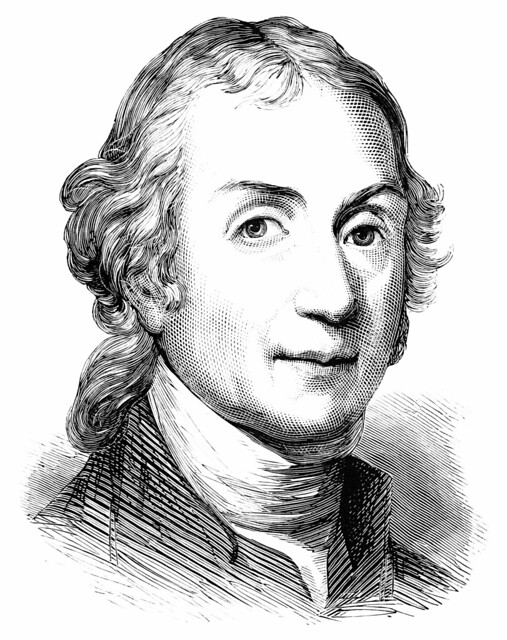
If you’re as much of a history buff as I am, you’re no doubt aware that HBO is currently airing a seven-part miniseries on John Adams, based on the popular Pulitzer-winning book of the same name by David McCullough. I confess I haven’t watched it yet. It’s building up in my Tivo queue so I can watch it all at once. I also didn’t read the book, though I’ve read McCullough’s 1776 and plenty of other books about the same period in history. I’ve always been fascinated by that time in our history, not least of which because my ancestors came to Pennsylvania from Switzerland in the early 1700s. The son of my original descendant in America—at least on my mother’s side—even fought in the war before returning to take over the family farm near what today is Bernville, Pennsylvania.
But according to some reviews, Samuel Adams is portrayed as “little more than a common thug whose idea of a good time is watching British dudes get Gatoraded with tar” and as “a leering, ranting, even dangerous fanatic … the very image of the corrupt urban politician.” Another reviewer says Samuel is “a character who seems at once both sinister and benign” and wonders when he’ll “finally give the others a taste of that new ale he’s been raving about?”
But Jeremy A. Stern, a historian writing on the History News Network, tells a different tale. His article, entitled What’s Inaccurate About the New HBO Series on John Adams, points out a number of inaccuracies from the first episode alone, before launching into his Sam Adams defense.
|
A portrait of Samuel Adams by one of the most well-known artists of the time, John Singleton Copley, painted around 1774, two years before the events in episode one of the HBO miniseries, when he would have been 50 years of age. Today it hangs in the Boston Museum of Fine Arts. |
Certainly, this testimony to Samuel’s ‘gentility’ is absent from the HBO program, which shows him practically as a dockyard thug – and yet at the same time ironically suggests that he is rich, and thus at leisure to pursue his devious wiles. This contradictory claim ignores John’s actual worry about Samuel’s neglect of himself and his own: Samuel was in fact in constant financial trouble, often dependent on the charity of his friends. Praise for Samuel’s character went beyond Massachusetts. In 1819, Thomas Jefferson, who had no reason to polish Samuel’s record, wrote almost as fulsome a tribute: “I can say that he was truly a great man, wise in council, fertile in resources, immoveable in his purposes.”
In the Boston Globe’s own condemnation of the series’ inaccuracies, they also mention a local historical researcher, James Bell, and his blog, Boston 1775. He, too, has posted a raft of inaccuracies not only about the miniseries itself, but specifically about Samuel Adams.
There’s more, too, both by Stern and Bell, but I’ll let you read that at your leisure, if you’re interested. Suffice it to say that historical dramas are almost always riddled with inaccuracies, that’s certainly nothing new. Usually, the excuse is something like “dramatic license” or “pacing” or some other story-driven nonsense. Of course, people watch history shows like this expecting them to be accurate, so I think it’s doubly bad when they’re not. But accepting that it’s just entertainment is harder to justify when you realize that HBO sent out leaflets to 10,000 teachers with “John Adams” agitprop urging them to show it to their classes. Of course, history textbooks are already riddled with mistakes, inaccuracies and propaganda, so maybe it doesn’t matter (for a wonderful book on this subject, see James W. Loewen’s Lies My Teacher Told Me). But it still seems weird that a Pulitzer Prize winning novel would be so compromised, but such is the way of the entertainment business. I’m thirsty now. Who wants to join me for a Samuel Adams Boston Lager.
If you enjoyed this post or the Bulletin generally, please consider buying me a pint
Hilarious. I love this story of British publicans taking matters into their own hands. It seems the Chancellor of the Exchequer, Alistair Darling, placed a 4p increase on the price of a pint, at a time when a pint already costs 25p more than it did one month ago, plus has “pledged to raise duty on alcohol by 2% above inflation for the next four years.” His budget is seen as only helping supermarket chains, whose share of the beer market has increased due to cheap pricing, which many have termed “pretty irresponsible alcohol retailing.” Pubs had already been losing ground to retail pricing wars and had asked for a freeze on prices to hep save pubs. Apparently, Darling was deaf to their concerns and now they’ve responded by banning him from every pub in England (or at least in all the participating ones—which after one day numbers 170). Obviously, the actual banning will do little to change things, but presumably the attendant publicity might.
They’ve created a poster which they’re encouraging pub owners to display in the window of their establishment featuring Darling behind bars and the word BARRED in large block letters.
It’s even spread to Brussels, where at least one pub—O’Farrells—has also put the poster in their front window. UK Independence Party head Nigel Farage noticed while there earlier today, about which he is quoted.
“Every politician who voted for the smoking ban and an increase in alcohol taxes at this difficult time for our pubs should be banned,” said Farage.
“However, most of our politicians are so detached from reality that they probably don’t visit pubs.”
They’ve also set up a group about the ban on Facebook.
I can think of plenty of our own politicians we should do likewise with.
This is the poster is available for download.
![]()
Yesterday the California Board of Equalization made a troubling ruling that has the potential to threaten the production of all barrel-aged beer in the state. The changes were urged by neo-prohibitionists in their misguided attempt to have Alcopops taxed at the higher distilled spirits rate instead of as beer (or more technically malt-based beverages). But the language, perhaps unintentionally, makes it possible to be applied to any beer that’s been aged in a used wooden barrel. Here’s the relevant language from the ruling:
any alcoholic beverage, except wine, which contains 0.5 percent or more alcohol by volume from flavors or ingredients containing alcohol obtained from the distillation of fermented agricultural products will be classified as a distilled spirit for tax purposes.
Brewers will be “required” to “prove” their beer doesn’t meet that criteria, meaning they’ll have to submit a form for every current and new beer they produce, a ridiculous requirement at best. Effectively they’ll have to “prove” each beer they make is really a beer, and not something else. Guilty until they prove themselves innocent. And who better to monitor that than a tax organization, with little or no brewing knowledge? Since distilled spirits are taxed at a much higher rate, they’ll have no incentive whatsoever to act fairly. To me, this has disaster written all over it. In California, we’re facing a huge budget deficit and beer makes a convenient bogeyman to help pay for other people’s mistakes.
Also, under the ruling the Board of Equalization will give itself the authority to define and implement regulations applying to alcohol, a power previously reserved for the legislature (and enforced by the ABC). That, too, I find disturbing. Tax authorities regulating alcohol do not exactly have a good track record.
But let’s get back to calling a beer a distilled spirit just because it touched wood that used to have one in it. I can’t even fathom why, apart from economic greed, that makes any kind of sense. It’s just wrong on so many levels.
I may spend time abroad in a foreign land and be forever changed for the experience. Perhaps if I go for any length of time to … let’s say Canada, I might start paying closer attention to hockey, or even curling. Maybe I’ll start calling a case of beer a “two-four,” spelling colour with a “u,” hanging prints by one of the Gang of Seven in my home, or quoting Louis Riel, eh? But I’ll still be an American. The same is true for beer. A stout may spend years in a bourbon barrel, taking on rich vanilla character and other flavors from its time in the wood. But it will still be a 5% abv stout. To suggest it will turn into Maker’s Mark, even just for “tax purposes,” is an insult to common sense.
Aging beer in wooden barrels has, of course, become quite common and I’d say many, if not most, California craft brewers are making a beer of this type at least from time to time. And there are several that have made names for themselves with their barrel aged beers, such as Russian River and the Lost Abbey, to name two prominent ones. Their entire business will be under threat if the ABC decides to apply this ruling to these beers. The higher taxes will make them too expensive to produce.
The EU did something similar a year or so ago, when they tried to implement a requirement that all breweries meet a standard of cleanliness, inadvertently threatening all lambic breweries, whose wild yeast microcosms would have been destroyed under the proposed regulations. I’m pretty sure an exception was worked out, but the general public has a bit better appreciation for beer in Europe than on our shores.
Paranoid? Maybe, but I love these beers far too much to leave it to chance. Something needs to be done, but at this early stage I don’t even know what or who this can be appealed to. I’ll keep you posted. But I’m sure your local state representative will be involved. Find out who yours is now, and be ready to send him a letter or e-mail. Hopefully, I’ll have details soon on what we all can do.
If you enjoyed this post or the Bulletin generally, please consider buying me a pint
I was forwarded this something like fourth-hand, but I’ve been assured it’s also on Magic Hat Brewing’s website (though I couldn’t find it) and was created by them as a goof. I think it’s pretty funny, but then I have a dark, twisted sense of humor. If you’ve been following the Hookergate scandal in the New York Governor’s office you know the former top dog was referred to as customer #9. But there’s already a beer by that name, but you probably already knew that ….

If you enjoyed this post or the Bulletin generally, please consider buying me a pint
This doesn’t have anything to do with beer, but someone sent me a link (thanks, Cindy) correctly believing I’d enjoy it. In fact, it’s surreal, weird and perversely hilarious. Food Fight is simply the history of warfare since World War II told through food fights, with national foods representing each country, or as the Food Fight website put is.
Food Fight is an abridged history of war, from World War II to present day, told through the foods of the countries in conflict. Watch as traditional comestibles slug it out for world domination in this chronologically re-enacted smorgasbord of aggression.
They’ve also thoughtfully provided a cheat sheet listing all of the foods in the film and which nation they’re associated with. And since it’s war, expect a lot of ketchup. Enjoy.
If you enjoyed this post or the Bulletin generally, please consider buying me a pint
There was an interesting item in yesterday’s USA Today called Frustration Over Liquor Laws Brewing. The story details just a few of the battles around the country to update their state’s antiquated alcohol laws, which in many cases haven’t been updated since Prohibition’s repeal in 1933. I’m sure the neo-prohibitionists will be fighting these tooth and nail, employing their usual bag of dirty tricks, but perhaps it’s finally time to stop playing defense and pick up the ball. In Mississippi, for example, it’s still illegal to sell beer in excess of 6% abv. The argument against raising it, predictably, is, according to William Perkins of the Mississippi Baptist Convention Board, that an “intellectual argument ignores the ill effects of alcohol.” Well, I’d sure hate for logic or intelligence to interfere with his world view, but you can buy wine and liquor in Mississippi already and, unless it’s some weird watered-down varieties, those are all well above 6% so please tell me how that makes any sense whatsoever? Not to mention there are plenty of positive health claims that can be made not only about beer, but the moderate use of alcohol in general. If Perkins’ thinking shows nothing else, it’s illustrative that logic plays no role at all in the anti-alcohol league’s canon. By any means necessary seems to be the only rule. So perhaps it’s time to mount an offensive. After all, a good defensive very well may be a strong offense.
If you enjoyed this post or the Bulletin generally, please consider buying me a pint
This Chronicle article comes to me via a local political blog, The Left Coaster, which curiously is also the name of the regular column I write for the Ale Street News, which in turn is located on the other coast.
|
Matier and Ross’ column today, The Bay Area could be the Clinton-Obama decider, contains this bit of wisdom from long-time state pollster Mark DiCamillo, dividing democratic voting patterns according to one’s preference for beer or wine.
I’m not exactly sure what to make of that. You’d have to search far and wide to find someone more liberal than myself, I’m reasonably well-educated, but I definitely would prefer to pair that cheese with beer. After all, the notion that wine and cheese work well together is really just a myth. And frankly, either candidate on those labels is pretty scary looking. |
Not surprisingly, most of my friends are like-minded, so either DiCamillo is way off the mark or more probably, I’m so far removed from the pulse of the people that I don’t even register. I’m most likely the guy in their 2% plus or minus margin for error, so rarely do I agree with any of the choices polls usually offer. For example I’m not particularly wild about either Clinton or Obama, and think our media is doing its usual disservice to society by so nakedly picking sides so early in the campaign process. All the candidates are supposed to get equal time, but because they cover only who they want to and who they decide are the front-runners, it’s a self-fulfilling prophecy that subverts the very idea of a democracy.
But enough proof that I’m on the fringe, is DiCamillo suggesting that the more liberal and/or educated one is, the more likely that person is to prefer wine over beer? With Sonoma and Napa Counties, along with several others, so close to the Bay Area, it’s no surprise that we’re awash in wine lovers. But perhaps DiCamillo is unaware that this same area, the San Francisco Bay Area, might also be the second most important region in the country for craft beer. And the demographic that most frequently goes for craft beer? You guessed it; liberal and educated. Of course, craft beer drinkers are only a fraction of the total beer picture (though in the Bay Area we’re well above the national average) but doesn’t cheap table and box wine sell pretty well, too? And lets not ignore the many people who enjoy both beer and wine.
My only point in all of this is to ponder whether or not the traditional stereotype of beer as blue-collar and wine as white-collar might not be as true as it once was (if indeed it really ever was true), and especially when applied to craft beer? Better beer seems to cut across class lines to a great extent, at least it seems to me that you see all stratas of people at beer festivals, beer dinners and the like.
According to Ross and Matier, “[t]he big showdown between Hillary Clinton and Barack Obama could come down to California’s ‘beer-drinking Democrats’ versus its ‘wine and cheese’ liberals — with the Bay Area playing a pivotal role in the outcome.” I’m not sure about those labels, they just seem a bit outdated and too simple-minded for my tastes.
If you enjoyed this post or the Bulletin generally, please consider buying me a pint
Click on the Links Below to Support the Beer Bulletin |
[powered by WordPress.]
For more dates, visit the Brookston Almanac
For additional dates and more info, visit the |
From Topix, place your cursor over the headlines to link to the full story