

I stumbled upon this interesting write-up of the Beers of Martin Luther on a Lutheran website, Cyberbrethern. The post is based on notes from a talk given at a Men’s Breakfast at Good Shepherd Lutheran Church, Fayetteville, New York in April of 1997. Keith Villa of Blue Moon Brewing is thanked for “describing how the beers of Martin Luther’s era would have looked and tasted.”
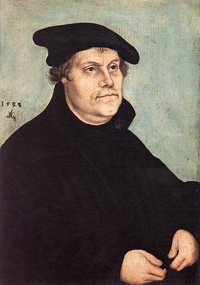
The article discusses German beer in the middle ages, both homebrewed beer and brews made at Abbeys, and then speculates which beer of the time would have been Martin Luther’s favorite. This proved easier than you might imagine.
Frederick Salem, in his Beer, Its History and Its Economic Value as a National Beverage (1880) notes, “Luther’s fondness for beer is well known, and on the evening of that eventful day at Worms, April 18, 1521, the Duke Erich von Braunschweig sent him a pot of Eimbecker (Einbecker) beer, to which he was specially addicted.”
Michael Jackson also mentioned this connection in his New World Guide to Beer, saying “Luther received a gift of Einbeck beer on the occasion of his wedding.”
The article goes on to suggest that Luther preferred homebrew over beer from commercial breweries, finding the latter to be “a curse for Germany.” But in an apparent contradiction, Luther “drank at home.”
One biographer notes, “The German prophet became a patriarch, and the living room was dominated by his presence. He enjoyed his beer and had a great mug with three rings on it, one ‘the Ten Commandments’, the next ‘the Creed’ and third ‘the Lord’s Prayer’. He boasted that he could encompass all three with ease.”
But he was also a champion for moderation, and in sermon he gave in 1539, preached the following:
“It is possible to tolerate a little elevation, when a man takes a drink or two too much after working hard and when he is feeling low. This must be called a frolic. But to sit day and night, pouring it in and pouring it out again, is piggish… all food is a matter of freedom, even a modest drink for one’s pleasure. If you do not wish to conduct yourself this way, if you are going to go beyond this and be a born pig and guzzle beer and wine, then, if this cannot be stopped by the rulers, you must know that you cannot be saved. For God will not admit such piggish drinkers into the kingdom of heaven [cf. Gal. 5:19-21]… If you are tired and downhearted, take a drink; but this does not mean being a pig and doing nothing but gorging and swilling… You should be moderate and sober; this means that we should not be drunken, though we may be exhilarated.”
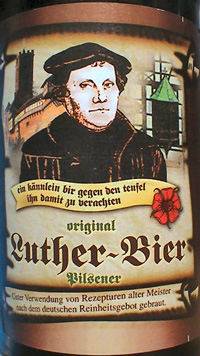
There is at least one Luther-Bier, a German-style pilsner brewed by Einsiedler Brauhaus. I’m not sure what that adds to the story, but I found in interesting all the same. As far as I can tell, it was a special release and there’s even a separate website for Luther-Bier, but there’s almost no additional information there. But you can see the special box it comes in an etched mug at a Wittenberg website.
And I found this great quote on another church’s website:
“We old folks have to find our cushions and pillows in our tankards. Strong beer is the milk of the old.”
— Martin Luther
This is fun stuff, Jay! Being that I have a graduate degree in Theology and Church History, I always enjoy hearing tidbits about the prominent role beer played in Christendom’s history – the post-Reformation heritage is particularly rich and Luther particularly quotable!
In Britain too, beer was an important commodity for monasteries up until the 16th Century. The Domesday Book, a nationwide survey made in 1086 has St Pauls in London brewing around 1900 barrels a year whereas the monks at Fountains Abbey, Yorkshire, in later centuries, brewed a staggering 60 barrels every ten days – 21,900 barrels annually.
After Thomas a Becket was murdered in Canterbury Cathedral in 1170 pilgrimages to his shrine (and other religious sites in Britain) became popular. At first travellers sought overnight refuge in monasteries but, when the numbers became too great, roadside inns were established, often taking religious names to imply a monastic connection. Obviously a great deal of beer was brewed to meet their needs, the water of the time being unsafe to drink.
In an odd twist of fate and considering what the tourist trade owes to him, Thomas a Becket had trained as a brewer during his time at ST Albans Abbey and is now the brewers’ patron saint.
One further monk/beer snippet. “Sceot” is an Old Norse word meaning “cut”. It was applied to a tax levied by the local sheriff, the money later being redistributed for the relief of the poor. (We still talk today about taking a cut.) Ale was one of the taxable items and, in order to raise money for the parish, monks sometimes brewed scot ale on special occasions, the proceeds being used for charitable purposes. Beer brewed secretly, without payment of this tax, was said to be “scot-free”.
Elaine Saunders
Author – A Book About Pub Names
http://www.completetext.com
Do you know of a quote ascribed to Martin Luther the gist of which is:
“I know the devil is active, but I also know God is sovereign, so I will sit here and drink my beer.”
I am Missouri Synod Lutheran and a beer drinker and tobacco smoker. I like drinking beer and I believe it is much better for you than hard liqour. Once you get used to drinking beer if you have a brain it doesn’t make you out of control. I wouldn’t suggest driving or operating heavy machinery.
The reason for Pilsnerbier not listed as a beer of Martin Luther is that it was yet to be invented for about 300 years. The light malt required continuous flow kilns for drying, lager yeasts did not show up until after Magellian circumnavigated the world and pick up a species of yeast that would mate with the traditional European ale strains and become cold adapted.
To enter the site “Luther-Bier” you have to click on the words “jetzt eintreten” (enter now) on the page at the link you provided above in your helpful story. There you will find a bunch of beers being produced in honor of the 500th anniversary of Luther’s Reformation in 2017. If you do that you’ll see there’s quite a lot in there besides, but you must know German, which is why you missed it!